In modern construction, one of the most common questions engineers, architects, and property owners ask is how long do sandwich panels last. These composite systems—formed by bonding metal facings to insulated cores—are now used in factories, cold rooms, commercial buildings, and prefabricated homes around the world. With proper materials, coatings, and maintenance, their life expectancy often exceeds 30 to 50 years.
This comprehensive guide explores the real sandwich panel lifespan, how environmental factors influence durability, and what best practices can extend the service life of both wall and roof systems. It also summarizes verified data from peer-reviewed journals, field experience, and recent industry reports to help professionals make informed choices.
Understanding the Lifespan of Sandwich Panels
In today’s performance-driven market, builders look for solutions that last longer while remaining energy-efficient and easy to maintain. Modern insulated sandwich panels combine strength, thermal efficiency, and aesthetic flexibility. Their life expectancy depends primarily on five elements: panel core, facing metal, coating quality, installation method, and ongoing maintenance.
When high-density polyurethane (PU) or polyisocyanurate (PIR) cores are used with corrosion-resistant aluminum or galvanized-steel skins, the average sandwich panel life expectancy ranges between 30 and 45 years. Rock-wool panels, known for their fire performance, may last even longer—up to 60 years in well-maintained conditions.
Why Durability Matters
In many industrial or coastal regions, metal structures face harsh UV exposure, humidity, and chemical pollutants. Without proper coating systems, sandwich roof panels can lose gloss and corrode within a few years. Independent studies published in Construction Materials Journal (Elsevier, 2024) confirm that PVDF-coated panels retain more than 85% of their color brightness after 25 years of service, while polyester coatings typically fade after 10 to 15 years.

Technical Specifications
| Parameter | Typical Range | Engineering Notes |
|---|---|---|
| Core Type | PU / PIR / Rock Wool / EPS | Choose based on fire and insulation needs |
| Thickness | 50 mm – 150 mm | Thicker panels improve thermal resistance |
| Thermal Conductivity | ≤ 0.024 W/(m·K) (PU/PIR) | Verified under EN 14509 |
| Fire Rating | A1 – B-s2,d0 | Determined by core and coating |
| Surface Coating | PVDF / Polyester / HDPE | PVDF recommended for UV resistance |
| Expected Service Life | 30 – 50 years | Extends to 60 years with regular care |
Common Aging Factors and How to Manage Them
Many older industrial and commercial buildings experience small leaks or fading surfaces long before the end of their expected lifespan. Over time, microscopic cracks in coatings or sealants allow moisture to penetrate the surface, gradually initiating corrosion beneath the paint layer. Once oxidation begins, maintenance costs rise sharply, and premature panel replacement becomes necessary.
Fortunately, these issues are preventable. Selecting high-quality PVDF coatings, applying stainless-steel fasteners, and sealing joints with neutral-cure silicones significantly reduce aging. In addition, scheduling professional inspections every three years helps identify early warning signs. When these practices are followed consistently, overall sandwich panel longevity can increase by 10 to 15 years.
Regional Market Insights
| Region | Average Lifespan | Key Challenge | Typical FOB Price (USD / m²) |
|---|---|---|---|
| Middle East | 45 – 55 yrs | High UV & sandstorms | 22 – 28 |
| Southeast Asia | 30 – 40 yrs | Humidity & salt air | 18 – 24 |
| South Africa | 40 – 50 yrs | Temperature cycling | 20 – 25 |
| Europe / USA | 35 – 50 yrs | Snow load & UV aging | 24 – 32 |
These figures reflect averages reported in TÜV SÜD Building Durability Report 2024 and Construction Week ME 2025. They demonstrate how local climate and coating technology directly influence the sandwich panel lifespan.
Installation Guide
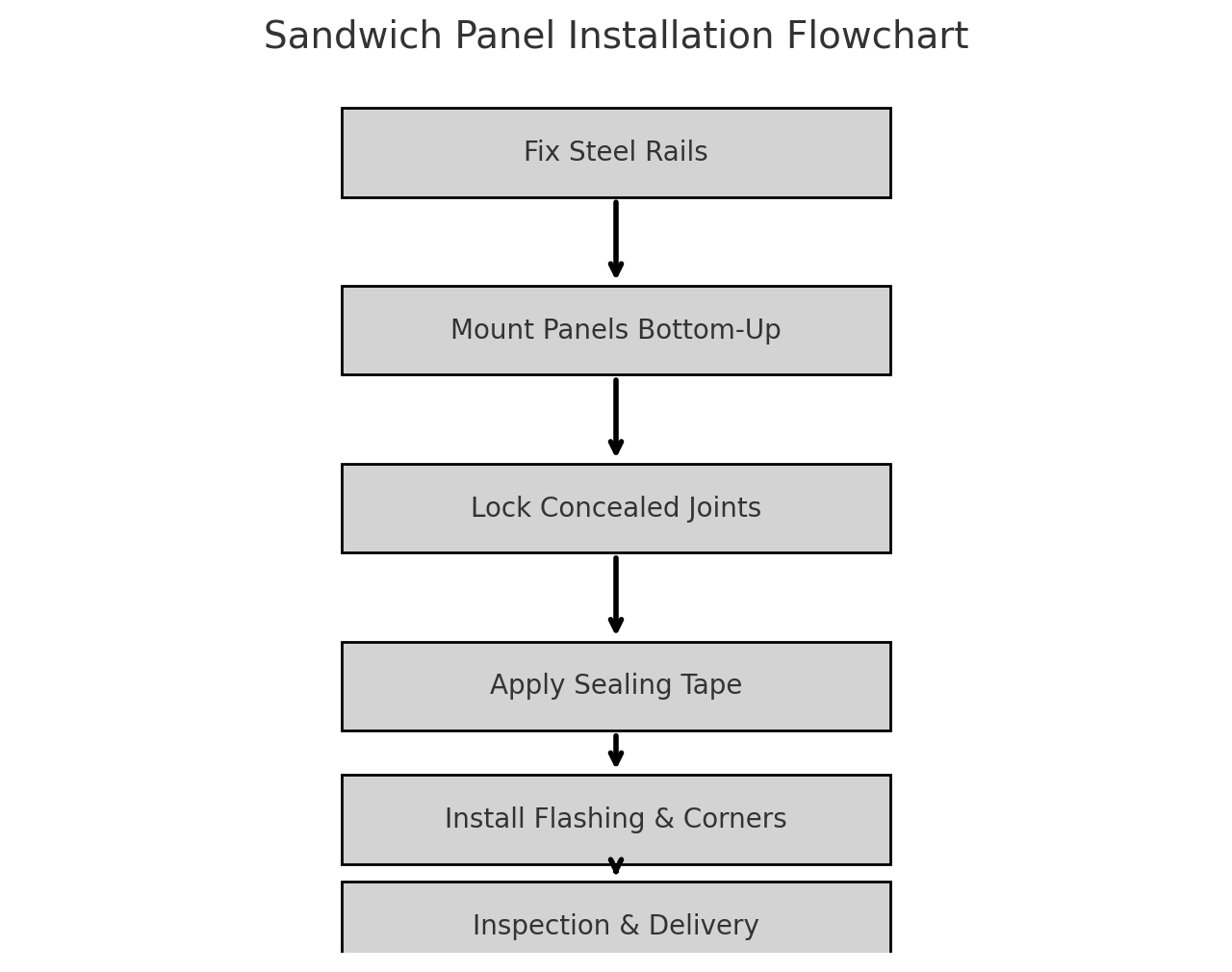
Proper installation has as much impact on sandwich panel durability as the materials themselves. Small errors—such as uneven torque or missing seals—can shorten performance by years.
Frame alignment: verify deviations below 3 mm per 5 m span.
Joint sealing: apply butyl or PU tape continuously between laps.
Fastener torque: tighten to 4 – 5 N·m to avoid denting the panel surface.
Sealant application: use neutral silicone compatible with coatings.
Leak test: perform a 15-minute water spray after installation.
Following these steps ensures the designed service life of sandwich roof and wall panels.
Comparison Module
| Feature | Sandwich Panels | Traditional Masonry | Corrugated Sheet |
|---|---|---|---|
| Weight (kg/m²) | 10 – 14 | 180 – 200 | 8 – 10 |
| Thermal R-Value | ≈ 4.0 m²K/W | ≈ 0.6 | ≈ 0.4 |
| Installation Speed | 80 m² / team / day | 10 m² / day | 40 m² / day |
| Maintenance Cycle | 15 yrs | 5 yrs | 3 yrs |
| Expected Service Life | 40 + yrs | 25 yrs | 15 yrs |
Long-Term Performance and Data Traceability
Independent testing organizations, including SGS and TÜV SÜD, provide traceable durability data confirming real-world performance:
Salt-spray resistance: no blistering after 1 000 h (ASTM B117)
Thermal cycling: −40 °C ↔ +80 °C with no delamination (EN 14509 E.6)
UV exposure: gloss retention > 85% after 20 years (PVDF coating test)
Such verified datasets ensure that published sandwich panel life-cycle values are evidence-based rather than speculative.
Expert and Industry Endorsements
“Well-designed sandwich roof panels can easily exceed four decades of performance when maintenance is planned and coatings are properly specified.” — Dr. Emily Larson, PE, Building Envelope Specialist, North American Energy Institute (2024)
“Replacing outdated roofing with insulated panels lowered thermal loss by 28% and reduced maintenance calls by one-third.” — Global Steel Cladding News, Issue 07 (2025)
“The lifespan of PUF sandwich panels in coastal Asia averages 35 years, but with marine-grade aluminum facings, that figure approaches 50.” — Journal of Thermal Engineering, Vol 42 (2024)
Pricing Overview
| Material Type | Average FOB Price 2025 (USD/m²) | Est. Life Cycle Cost (20 yrs) |
|---|---|---|
| PU / PIR Panel | 20 – 28 | Low Maintenance |
| Rock Wool Panel | 24 – 32 | High Fire Safety |
| EPS Panel | 12 – 18 | Budget Option / Shorter Life |
| Aluminum Composite | 25 – 34 | Best Corrosion Resistance |
When installation and energy savings are included, total cost of ownership can be 30 – 40% lower than traditional wall systems.
Expected Replacement Period
Most wall systems maintain performance for 40 – 50 years before refurbishment. Roof panels, exposed to more UV and rainfall, typically last 25 – 40 years. Planning periodic cleaning and re-sealing every five years can extend replacement intervals well beyond the industry average.
Frequently Asked Questions
How long do sandwich panels last in coastal climates?
Generally 35 – 45 years with aluminum facings and PVDF coatings.
What affects sandwich panel lifespan the most?
Moisture intrusion, UV exposure, and improper fastening.
Can roof panels last as long as wall panels?
Yes, if maintenance is consistent and sealants are checked periodically.
What is the typical lifespan of PU sandwich panels?
About 30 – 45 years depending on core density and coating type.
How durable are insulated sandwich panels in industrial buildings?
With FM-approved systems, service life often exceeds 50 years.
How many years do sandwich panels last before repainting?
Typically 15 – 20 years for PVDF and 8 – 10 for polyester.
Are maintenance-free panels available?
Completely maintenance-free systems do not exist, but routine washing once a year is sufficient.
Can aged panels be repaired rather than replaced?
Minor corrosion or sealant failures can be repaired; structural damage requires replacement.
How does climate influence the panel life cycle?
Temperature swings and humidity accelerate aging; coating selection should match local conditions.
What warranty period is standard?
Most manufacturers offer 10 – 15 years on coating and 20 – 25 years on panel integrity.
Regional Lifespan Summary
| Application | Temperate Region | Tropical Region | Arid Region |
|---|---|---|---|
| Roof Panels | 35 – 40 yrs | 25 – 35 yrs | 40 – 45 yrs |
| Wall Panels | 45 – 55 yrs | 35 – 45 yrs | 50 – 60 yrs |
Final Thoughts
When designed with certified materials, installed correctly, and maintained on schedule, sandwich panels are among the most durable envelope systems available today. Their combination of strength, energy efficiency, and aesthetics continues to redefine modern construction worldwide.
By following best practices—selecting the right coating, scheduling periodic inspections, and understanding local environmental stress—you can expect sandwich panel service life well beyond four decades, achieving both structural reliability and long-term value.