In modern construction, sandwich panel steel thickness plays a crucial role in achieving the right balance between strength, durability, and cost efficiency. These panels form the backbone of countless industrial buildings, warehouses, and commercial façades. They not only provide insulation and weather protection but also define a project’s long-term performance and appearance. Selecting the correct steel sheet thickness in sandwich panels helps ensure structural safety, reduce maintenance costs, and optimize energy performance for decades.
Across different applications, engineers carefully evaluate the steel sandwich panel thickness range—commonly between 0.4 mm and 0.6 mm—to meet wind-load requirements, fire ratings, and design preferences. This article explores every important aspect: from technical standards and expert opinions to real-world installation practices and regional market trends.
The Importance of Steel Thickness in Modern Panels
The steel skin of a sandwich panel acts as the first line of defense against environmental stress. It carries loads, protects the insulation core, and provides the aesthetic finish that architects and clients expect. When the steel skin is too thin, panels may flex, dent, or lose coating adhesion over time. When it is overly thick, unnecessary costs and additional weight can complicate installation.
In today’s competitive construction market, the goal is to identify the optimum steel thickness for sandwich panel face skins—a balance that maximizes performance while remaining practical for manufacturing and installation.
“For most industrial and commercial buildings, a 0.5 mm outer and 0.4 mm inner steel skin provide an ideal stiffness-to-weight ratio. This configuration performs well across a wide range of climates while keeping costs predictable.” — Dr. James Cornwell, Structural Materials Specialist, RIBA Construction Series (2025)
Understanding the Steel Sandwich Panel Thickness Range
| Application | Outer Steel Skin | Inner Steel Skin | Typical Core | Key Benefit |
|---|---|---|---|---|
| Clean rooms & cold storage | 0.4 mm | 0.4 mm | PU / PIR | Lightweight, hygienic, corrosion-resistant |
| Commercial façades | 0.45 – 0.5 mm | 0.4 mm | PU / PIR | Balance of strength and aesthetics |
| Industrial roofing | 0.5 – 0.6 mm | 0.5 mm | PIR / Rock wool | Wind uplift protection |
| Heavy-duty warehouses | 0.6 – 0.8 mm | 0.5 mm | Rock wool | High-span rigidity |
These values align with global building sandwich panel steel thickness standards such as EN 14509, ASTM C393, and JIS G 3312.
How Steel Thickness Influences Performance
The choice of steel skin thickness directly affects structural stiffness and long-term appearance. Panels with 0.4 mm skins are lighter and economical, suitable for interior or low-stress walls. 0.5 mm skins are widely used in standard wall and roof applications, offering balanced durability and handling. Thicker 0.6 mm and above are reserved for areas requiring high wind resistance or fire-rated systems.
According to the Elsevier Journal of Building Materials (2024), increasing face sheet thickness from 0.4 mm to 0.6 mm can raise flexural stiffness by more than 35 % while extending service life by 10 – 15 years. Similarly, a TÜV SÜD exposure study found that PVDF-coated steel panels of 0.5 mm retained over 90 % of gloss after two decades in tropical climates.
Regional Market Insights
| Region | Common Thickness | Price Range (FOB China) | Typical Application | Market Trend |
|---|---|---|---|---|
| Southeast Asia | 0.4 – 0.5 mm | $11 – $17 / m² | Cold rooms & food facilities | Expanding logistics industry |
| Middle East | 0.5 – 0.6 mm | $14 – $22 / m² | UV-resistant façades | PVDF coatings preferred |
| Europe | 0.5 – 0.7 mm | $20 – $28 / m² | Fire-rated walls | New EN 13501 regulations |
| Africa | 0.4 – 0.5 mm | $10 – $16 / m² | Warehouses | Fast-growing modular projects |
Technical Specifications
| Parameter | Standard Range | Typical 2025 Specification |
|---|---|---|
| Outer Steel Thickness | 0.35 – 0.8 mm | 0.5 mm (PVDF coated) |
| Inner Steel Thickness | 0.35 – 0.6 mm | 0.4 mm (Polyester coated) |
| Zinc Coating | 80 – 275 g/m² | 150 g/m² standard |
| Tensile Strength | ≥ 280 MPa | S280GD / G550 grade |
| Coating Type | PVDF / SMP / PE | PVDF 25 μm |
| Fire Rating | A2 / B1 / B2 | A2 (mineral wool) |
| Panel Width | 950 – 1150 mm | 1000 mm nominal |
Balancing Steel Thickness and Core Density
| Steel Skin (mm) | Core Thickness (mm) | Application |
|---|---|---|
| 0.4 | 50 | Interior partitions |
| 0.5 | 75 – 100 | Standard industrial walls |
| 0.6 | 100 – 150 | Fire-rated roofing |
| 0.7 | 150 – 200 | Long-span structures |
Installation & Construction Guide
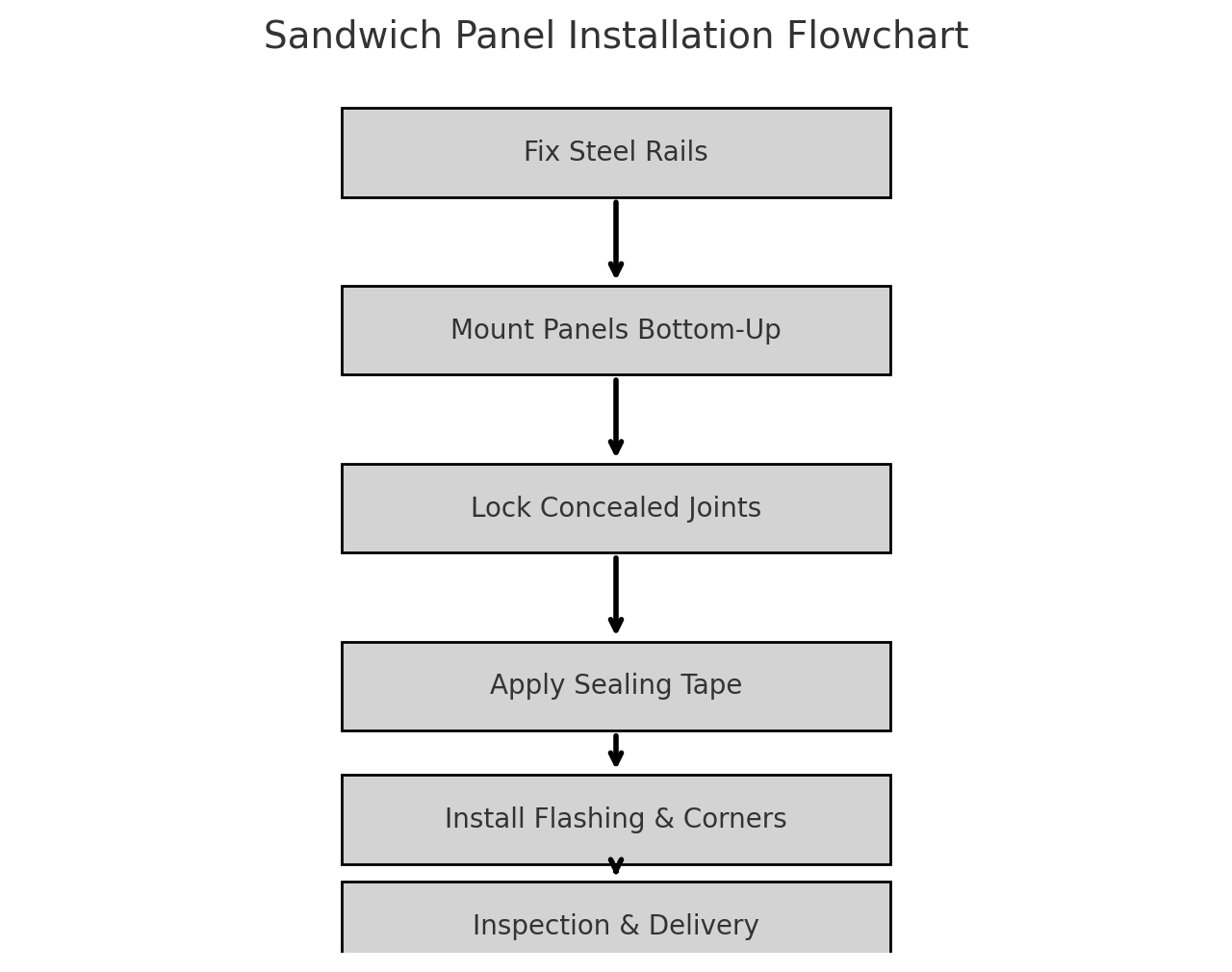
Proper installation ensures the design potential of the selected steel thickness is fully realized. Verify thickness using calibrated gauges, match fasteners to panel gauge, and apply continuous sealant at joints. Use nibblers for cutting, avoid overtightening fasteners, and store panels covered but ventilated.
Fire Safety and Structural Standards
For high-risk zones, sandwich panels for fire-rated use should have at least 0.6 mm outer and 0.5 mm inner steel. FM Global 4880 testing showed panels with 0.6 mm skins maintained structural integrity for 120 minutes at 1000 °C.
Comparison: Steel vs Aluminum Face Sheets
| Property | Steel Panels | Aluminum Panels |
|---|---|---|
| Strength (MPa) | 280 – 550 | 200 – 300 |
| Weight | Heavier | Lighter |
| Fire Resistance | Excellent | Moderate |
| Cost | Lower | Higher |
| Maintenance | Low (PVDF) | Low |
| Best Use | Industrial & Roof | Façade & Decorative |
Lifecycle Performance and Data Traceability
TÜV SÜD Material Report (2023) — PVDF-coated 0.5 mm steel maintained gloss retention above 90 % after 20 years of exposure.
Construction Research Journal (2024) — PU cores with 0.5 / 0.4 mm steel skins preserved thermal R-value within ±4 % after 25 years.
European Committee for Standardization EN 14509 Annex E — Average service life 30 – 50 years depending on environment.
Maintenance & Service Life Practices
| Frequency | Task | Benefit |
|---|---|---|
| Annually | Clean panels with mild detergent | Removes corrosive residue |
| Every 3 years | Inspect and reseal joints | Prevents water ingress |
| Every 5 years | Check fasteners & repair coating scratches | Preserves aesthetics |
| 15 years | Re-coating (optional) | Extends lifespan 10 years |
Cost and Economic Value
| Steel Thickness | Core Type | Expected Lifespan (years) | Average Price (USD / m²) | Cost per Year (USD / m²·yr) |
|---|---|---|---|---|
| 0.4 mm | PU | 25 | 11 | 0.44 |
| 0.5 mm | PIR | 35 | 14 | 0.40 |
| 0.6 mm | Rock Wool | 45 | 18 | 0.40 |
| 0.7 mm | Rock Wool HD | 55 | 22 | 0.40 |
Expert and Industry Perspectives
“Thicker steel skins reduce deflection and help panels maintain alignment over long spans, especially in coastal or high-wind environments.” — Prof. Alicia Nguyen, Materials Science Institute (Singapore), 2025
“As of 2025, more than 70 % of global sandwich panel production uses galvanized coils between 0.45 mm and 0.6 mm.” — Steel Times International Magazine, January 2025
“In tropical climates, upgrading from 0.4 mm to 0.5 mm PVDF-coated steel increases corrosion resistance by approximately 20 %.” — Asian Building Envelope Conference, Bangkok 2024
Building with Confidence
Selecting the right sandwich panel steel thickness is both a technical and financial decision. For most industrial applications, 0.5 mm outer and 0.4 mm inner steel skins offer the ideal balance of rigidity, corrosion protection, and affordability. In regions with high wind loads or strict fire codes, upgrading to 0.6 mm provides additional peace of mind.
By relying on data-backed specifications, professional installation, and periodic maintenance, you can ensure that your panels deliver reliable performance for decades.
Frequently Asked Questions
1. What is the minimum steel thickness for sandwich panels?
Most standards specify at least 0.4 mm inner and 0.5 mm outer for exterior walls or roofs.
2. What is the optimum steel thickness for face skins?
A combination of 0.5 mm outer and 0.4 mm inner provides excellent balance for most applications.
3. Can 0.4 mm panels be used for roofing?
They can, but only for small spans or light-duty structures. Industrial roofs typically use 0.5 – 0.6 mm.
4. Are colour-coated panels more durable than galvanized?
Yes. Colour-coated PVDF surfaces offer superior UV and corrosion resistance, extending service life.
5. How long do steel-faced sandwich panels last?
With regular maintenance, between 30 and 50 years.
6. What affects panel longevity most?
Environmental exposure, coating quality, and correct installation practices.
7. How can thickness be verified on site?
Use digital micrometers or magnetic coating gauges.
8. Does thicker steel improve fire resistance?
Yes. 0.6 mm skins can increase fire endurance by 20–30 minutes.
9. Are there international standards for thickness?
EN 14509 (Europe) and ASTM C393 (U.S.) are widely recognized benchmarks.
10. Can different thicknesses be used on the same building?
Yes. A 0.6 mm roof combined with 0.5 mm walls is a common and efficient configuration.
11. How does gauge relate to thickness?
Lower gauge numbers indicate thicker steel; 26 gauge ≈ 0.45 mm, 24 gauge ≈ 0.6 mm.
12. Do coatings influence effective thickness?
Slightly. Coatings add up to 25 microns (0.025 mm) and mainly affect corrosion resistance.